
CAPMAC / CARI-Navi
CARI-Navi · Ship propulsion-train healthYour propulsion train's health, at a glance.
Load your vessel's own logs and surveys: clutch, reversing gear, gearbox sensors, hydraulic servo, fin stabiliser, propeller pitch, hydraulic power unit, engine coolers, flexible coupling and stern tube, and the monitoring system's reversing-gear logs. Read one list per vessel in plain words, and print the report. Every finding says what was seen, how large it is and where to look first.
- Eleven machines, clutch to stern tube
- Plain words, where to look first
- Your own files, on your own PC
- One list per vessel, one printed report
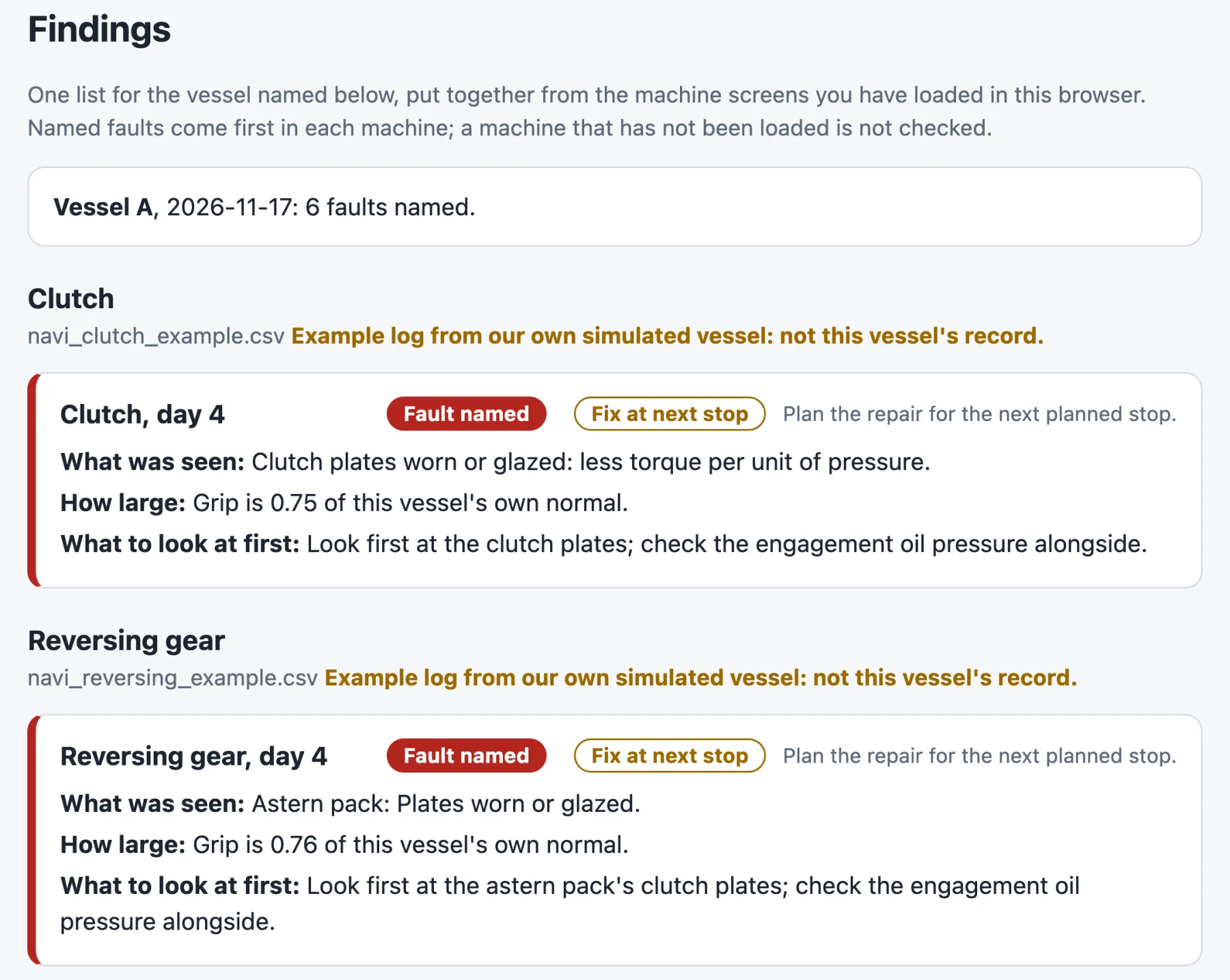
Watch the film
3 min 7 s, with captions. Sound on for the narration.
Open it. See what to look at first.
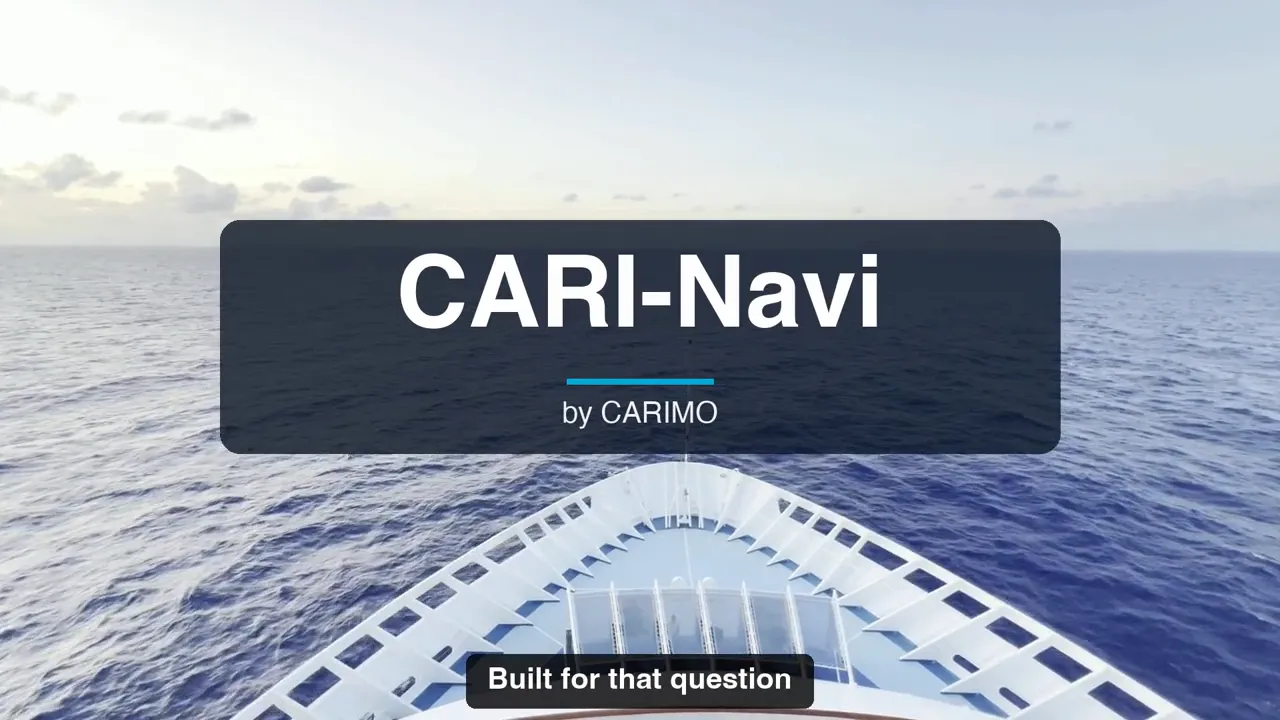
One list for the vessel: its name and date at the top, a block for each machine you loaded, named faults first. Each says what was seen, how large it is against the vessel's own normal, and where to look first.
What goes in. The latest result of each machine screen you have loaded: clutch, reversing gear (fast log or monitoring logs), gearbox sensors, hydraulic servo, fin stabiliser, propeller pitch, power unit, engine coolers, flexible coupling, stern tube. You add the vessel's name and the date.
What comes out. One list per vessel and date. A block for each machine, named faults first. Records with no named fault show “Nothing found”.
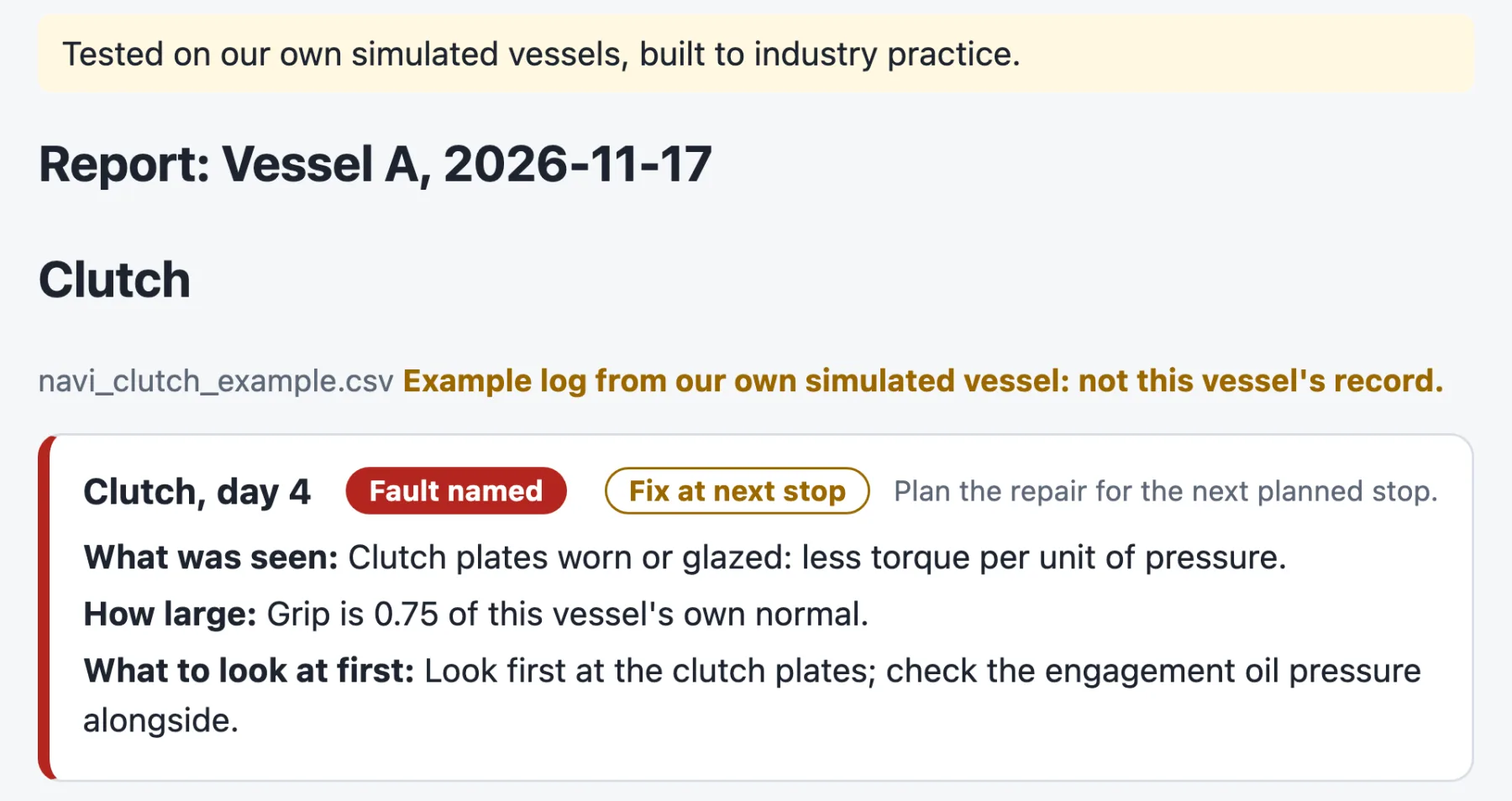
The printed report: one page per machine. Print from the browser, or save as PDF.
Seven areas. Eleven machines. One clear picture.
From the clutch to the stern tube, every area has its own screen and its own plain verdict.
1Clutch
Load your engagement log. Worn plates, low oil pressure, slow fill, drag, will not release. A heavier propeller is named as what it is, not as a clutch fault.
2Reversing gear
Load the log of both packs, or the monitoring system's engagement and running logs. The pack and the fault are named together.
3Gearbox sensors
Load your slow readings. A stuck, flattened or failed reading is named for what it is: a sensor problem.
4Hydraulics
Servo test moves, fin stabiliser log and propeller pitch test log, each read for its own named faults.
5Shaft life
Stern-tube survey readings and flexible coupling survey readings: years left, as a range.
6Power unit
Load the minute log and the load-cycle log: pump, pressure filter, oil cooler, internal leak, accumulator gas charge.
7Engine coolers
Load one log per cooler: will each cooler still do the cooling asked of it at the planned stop?
From the clutch to the stern tube.
Each machine is read from its own log or survey. Every finding ends with where to look first.
1Clutch
Grip, oil pressure, fill time, creep and slip at every engagement.
2Reversing gear
Ahead or astern pack, named with its fault, from a fast log.
3Reversing gear, monitoring log
Control-oil pump, late or failed engagement, from the alarm and monitoring logs. No torque meter needed.
4Gearbox sensors
Stuck, flattened or failed readings, named as sensor problems.
5Hydraulic servo
Weak pump, cylinder friction, worn valve lands, changed hold current.
6Fin stabiliser
Internal leak, silted valve, weak supply or hot oil.
7Propeller pitch
Worn oil-box side lands, worn centre land or a weak pump.
8Hydraulic power unit
Pump, pressure filter, oil cooler, internal leaks and accumulator gas charge.
9Engine coolers
Jacket-water, central (seawater) and lube-oil: enough cooling at the planned stop?
10Flexible coupling
Softened or stiffer since its first survey; years left as a range.
11Stern-tube bearing
Years left to the class-rule clearance, as a range and a best guess.
See clutch grip fall, engagement by engagement.
Each engagement's grip is drawn against the vessel's own normal days. When grip falls below the fault line, the screen names the fault.
What goes in. Engine and shaft speed, clutch oil pressure, the engage command and the shaft torque meter, from every engagement.
What comes out. A verdict in words: worn plates, low pressure, slow fill, drag, will not release. Or: not a clutch fault, the propeller is heavier.
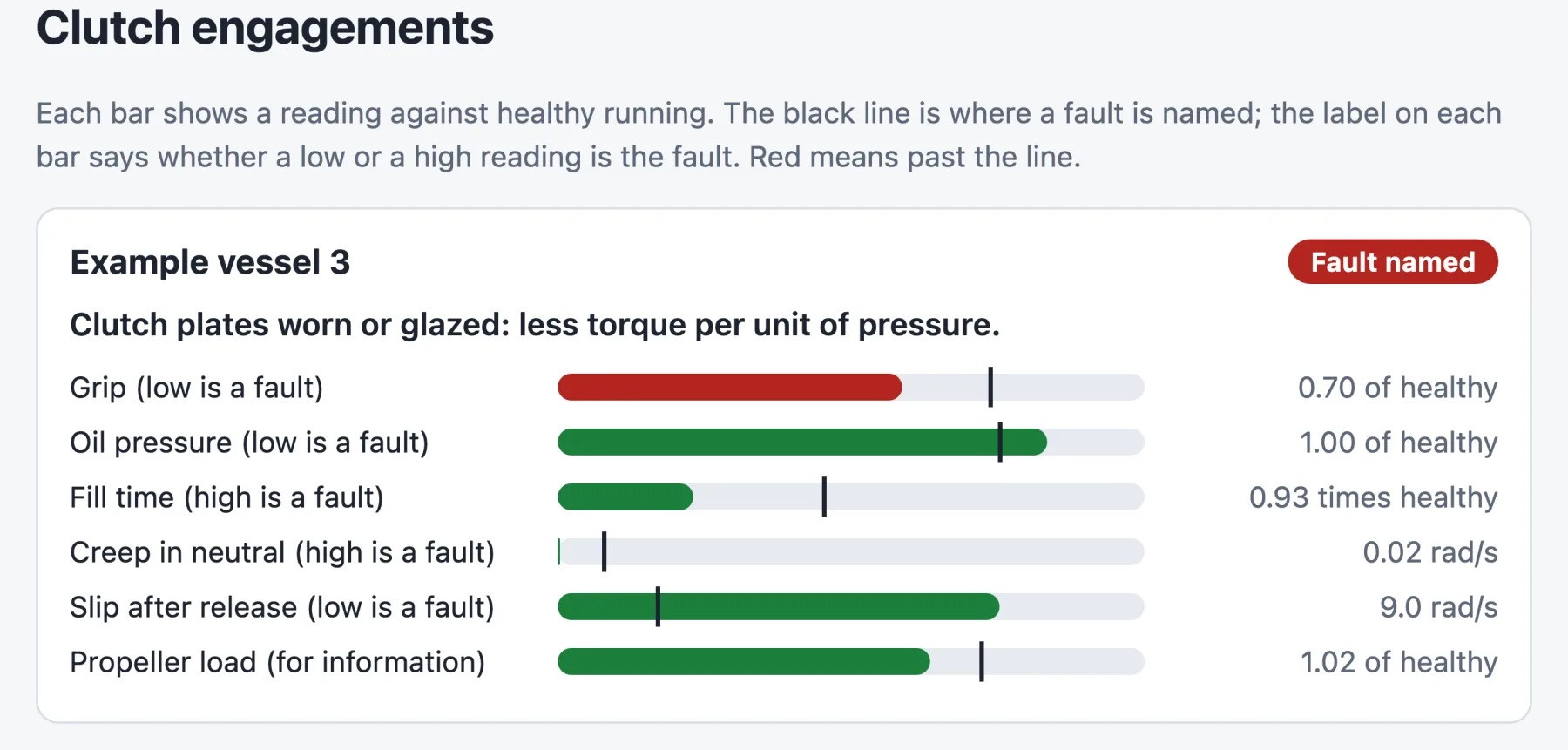
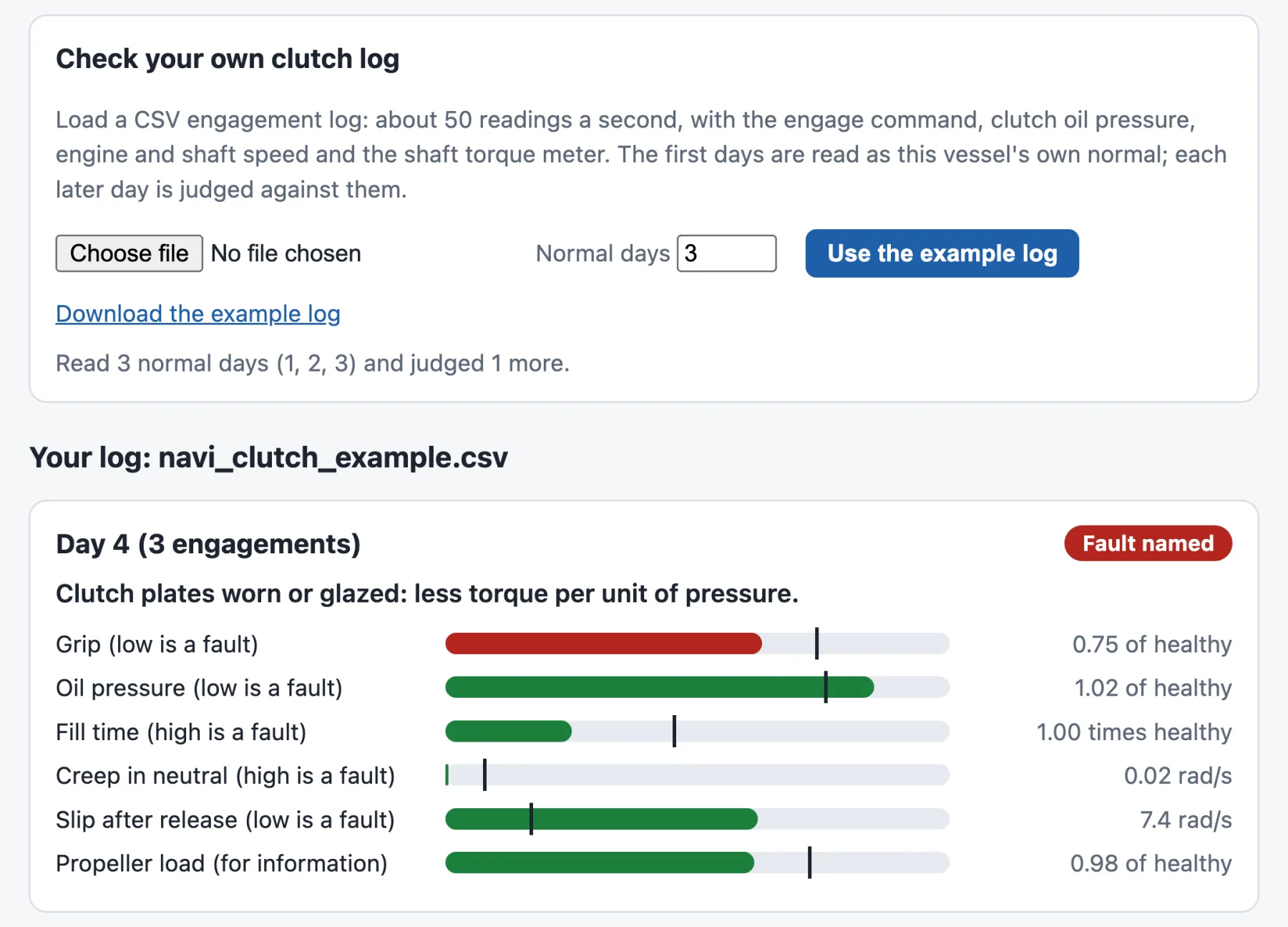
Load your clutch log. Read the verdict on the same screen.
Pick a CSV file, say how many days were normal, and the Clutch screen judges every later day against them. An example log comes with it.
Each later day gets its own card: grip, oil pressure, fill time, creep, slip, propeller load. About 50 readings a second, one every 0.02 s for each engagement. The days you name as normal set this vessel's own normal.
What goes in. A CSV file, about 50 readings a second. It holds the time, the engage command, clutch oil pressure, engine and shaft speed and shaft torque, for each day and engine. At least three days: two normal and one to judge.
What comes out. A card for each judged day: the fault named in words, six labelled bars, and where to look first.
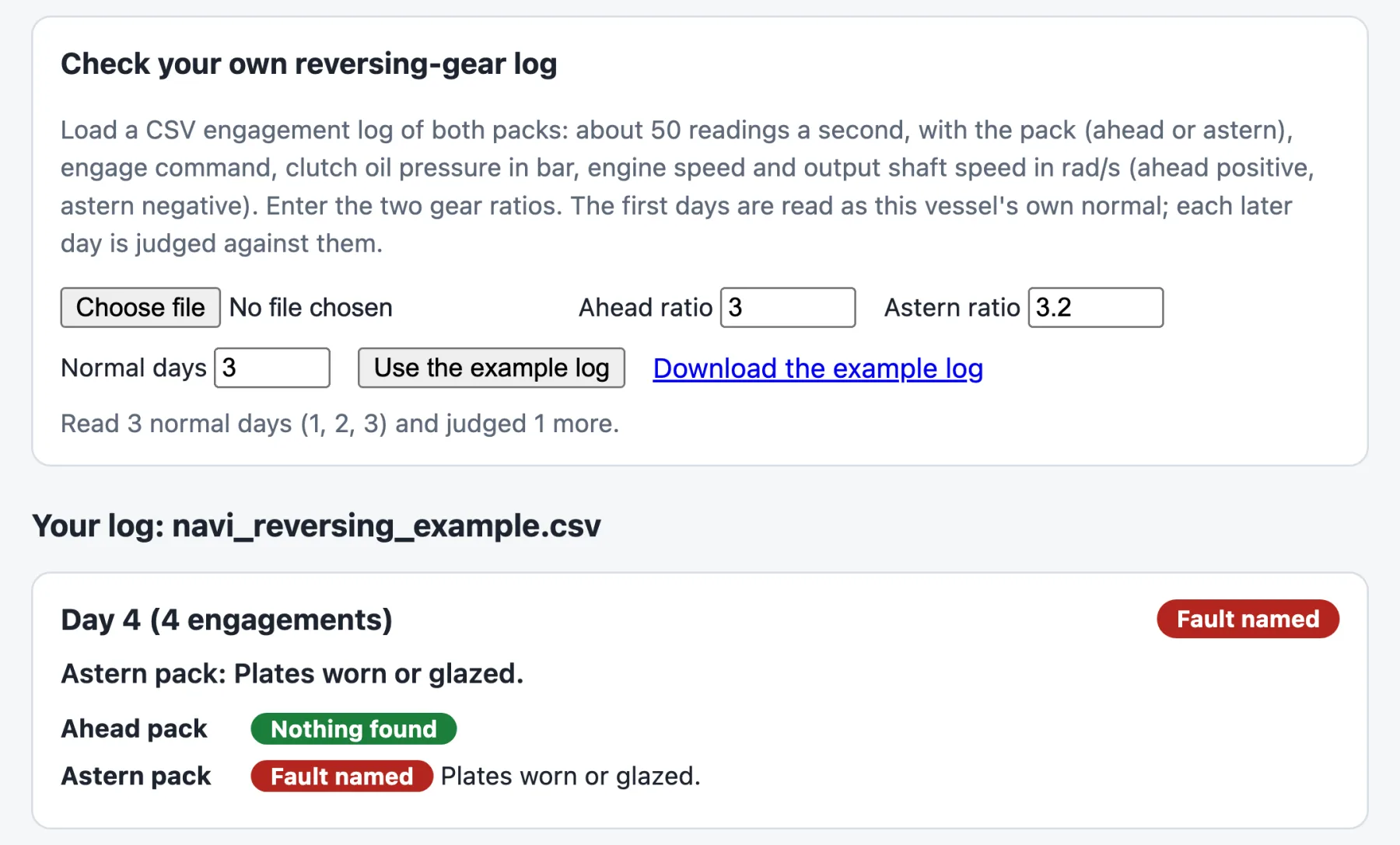
Ahead or astern, it names the pack.
Load the log of both packs. Each is read on its own against its own normal. The fault and the pack come out together. A fouled propeller is named as what it is, not as a pack fault.
What goes in. A CSV of both packs, about 50 readings a second. It holds the time, the pack (ahead or astern), the engage command, oil pressure, and engine and output speed, for each day and engine. You enter the two gear ratios.
What comes out. The pack and the fault, in words, for each judged day.
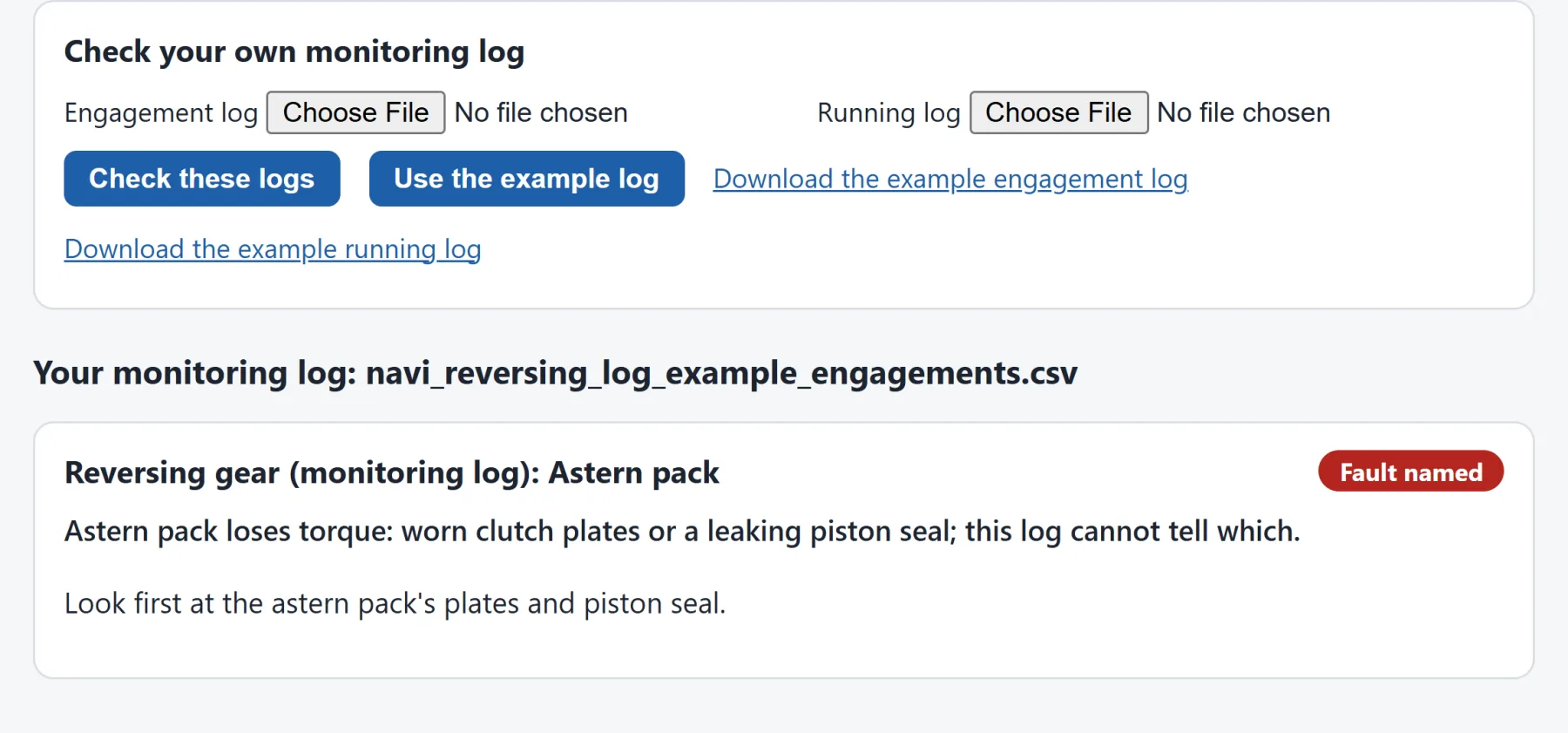
No torque meter? Use the monitoring log.
Load the engagement log and the running log from the alarm and monitoring system. The first days are read as this gear's normal; the last days are judged against them.
Control-oil pump worn, a pack engaging late, a pack losing torque or failing to engage, each with where to look first.
What goes in. An engagement log (day, hour, pack, engage time, slip energy, control-oil pressure) and a running log (day, pack, engine load, slip, control-oil pressure, gear oil temperature). No torque meter is needed.
What comes out. The pack and the fault in words, and where to look first. A cold morning, a gauge reading low or a heavier propeller is named as what it is, not called a gear fault.
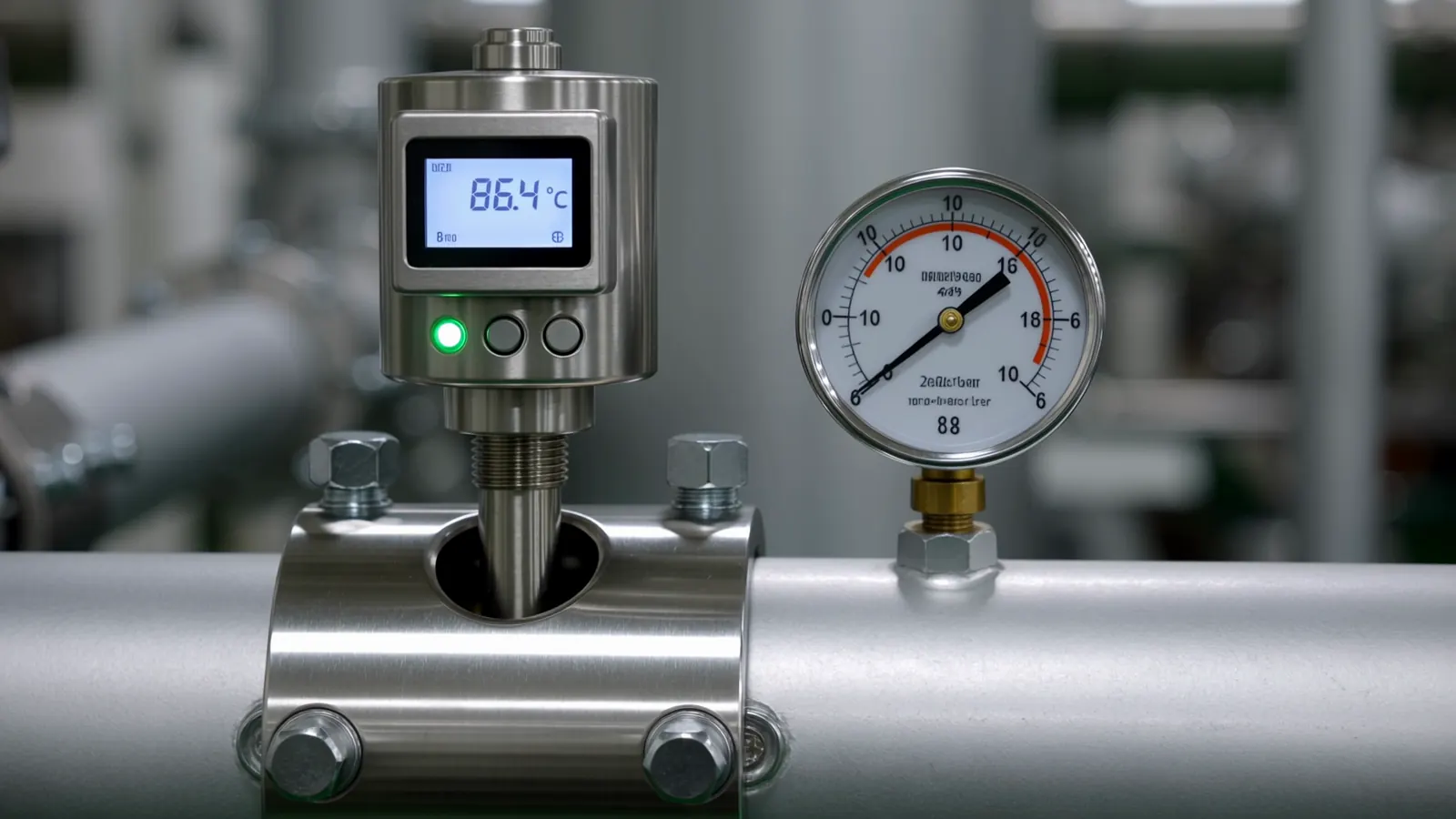
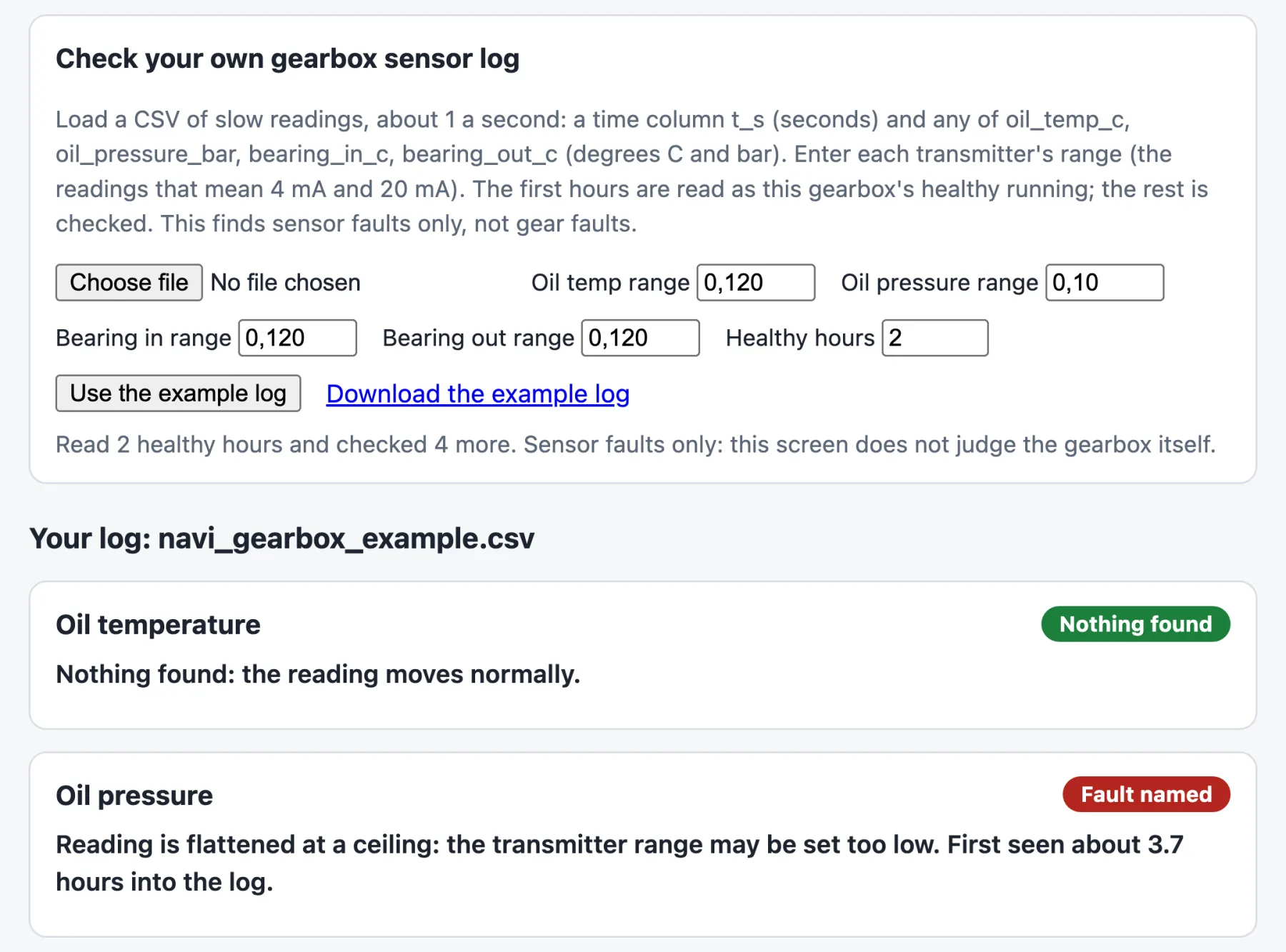
A failed sensor is named for what it is.
Load your slow readings. Each channel is checked on its own, and the time the problem was first seen is given.
What goes in. A CSV of slow readings, about one a second. It holds the time and any of oil temperature, oil pressure and the bearing temperatures. You enter each transmitter's range; the first healthy hours set the normal.
What comes out. Stuck, flattened and failed readings called out as sensor problems, with the time. A reading simply held at a limit by the process is left alone.
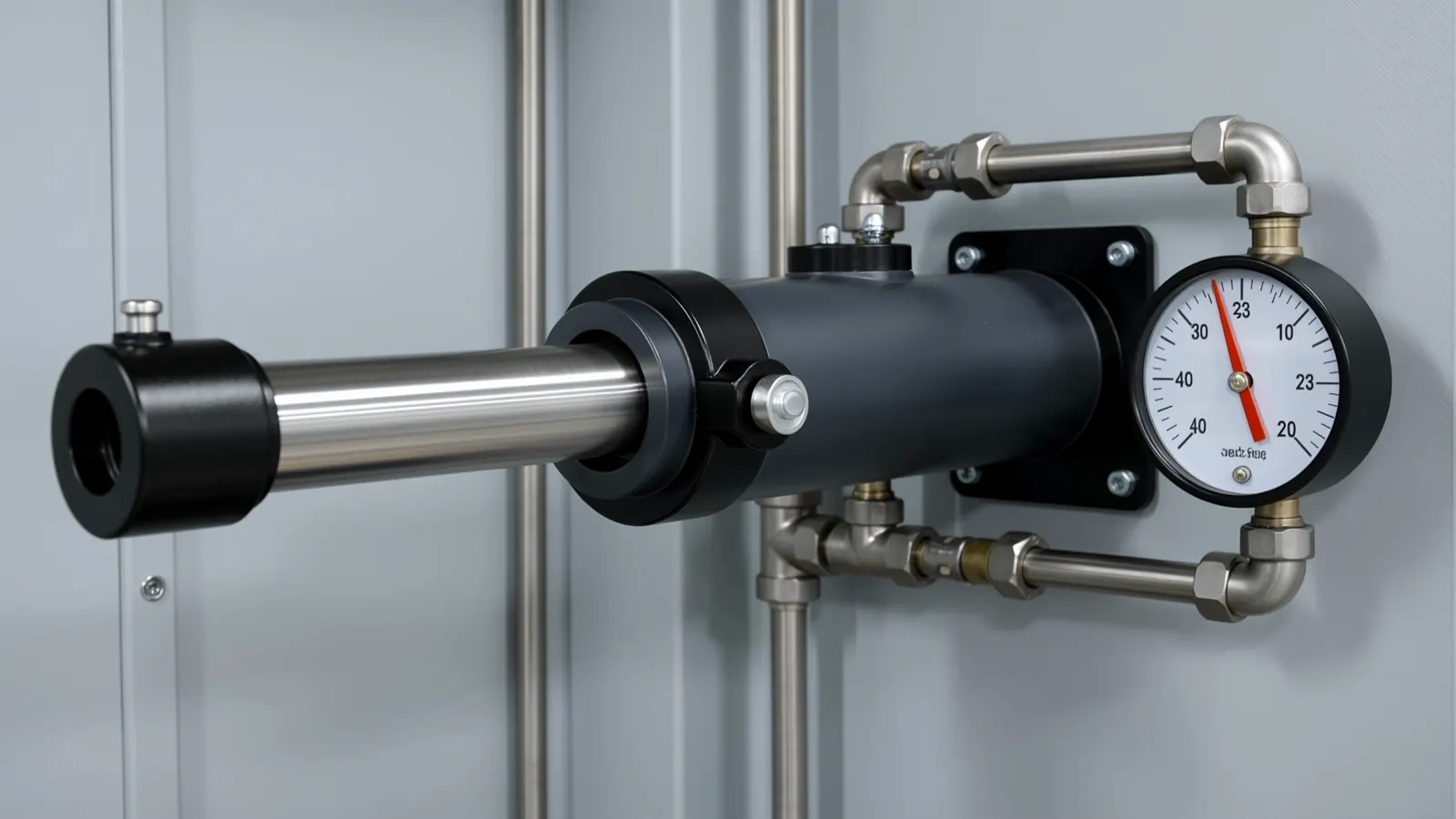
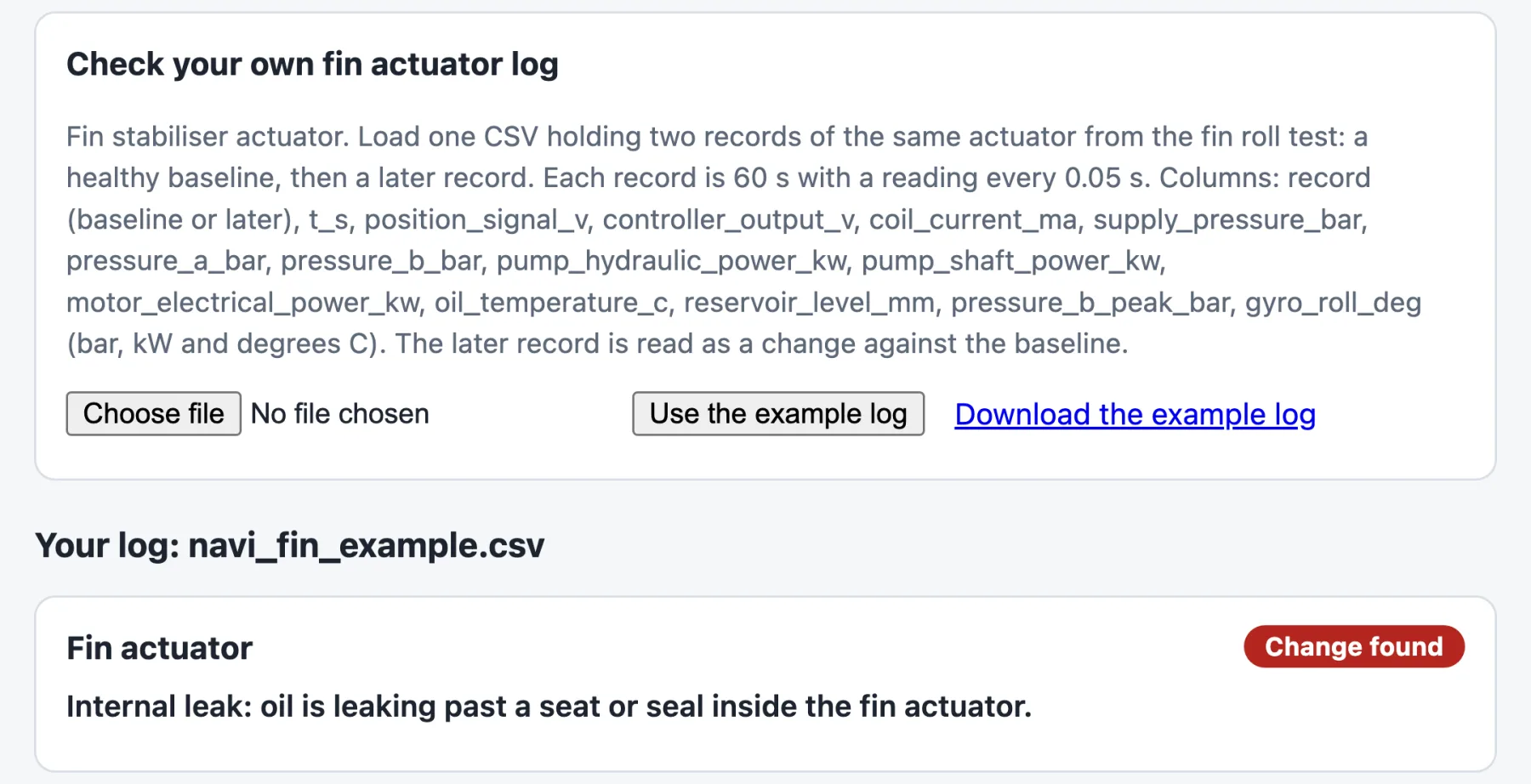
The servo, the fin and the pitch system read their own logs.
Load the repeated test-move log of a position servo, the log of a fin stabiliser actuator, or a propeller pitch test log. A reading across the black line is named. The bar shows how far.
What goes in. Servo: a CSV of repeated test moves, a reading every 10 ms for the 2.6 s move; the first healthy moves set the normal. Fin stabiliser: one CSV with a healthy baseline record and a later record, 60 s each, a reading every 0.05 s. Propeller pitch: one 12 s pitch test log, a reading every 0.01 s.
What comes out. Servo: a weak pump, cylinder friction, worn valve lands or a changed hold current. Fin stabiliser: an internal leak, a silted valve, a weak supply or hot oil. Propeller pitch: worn oil-box side lands, a worn centre land or a weak pump. Each named in words.
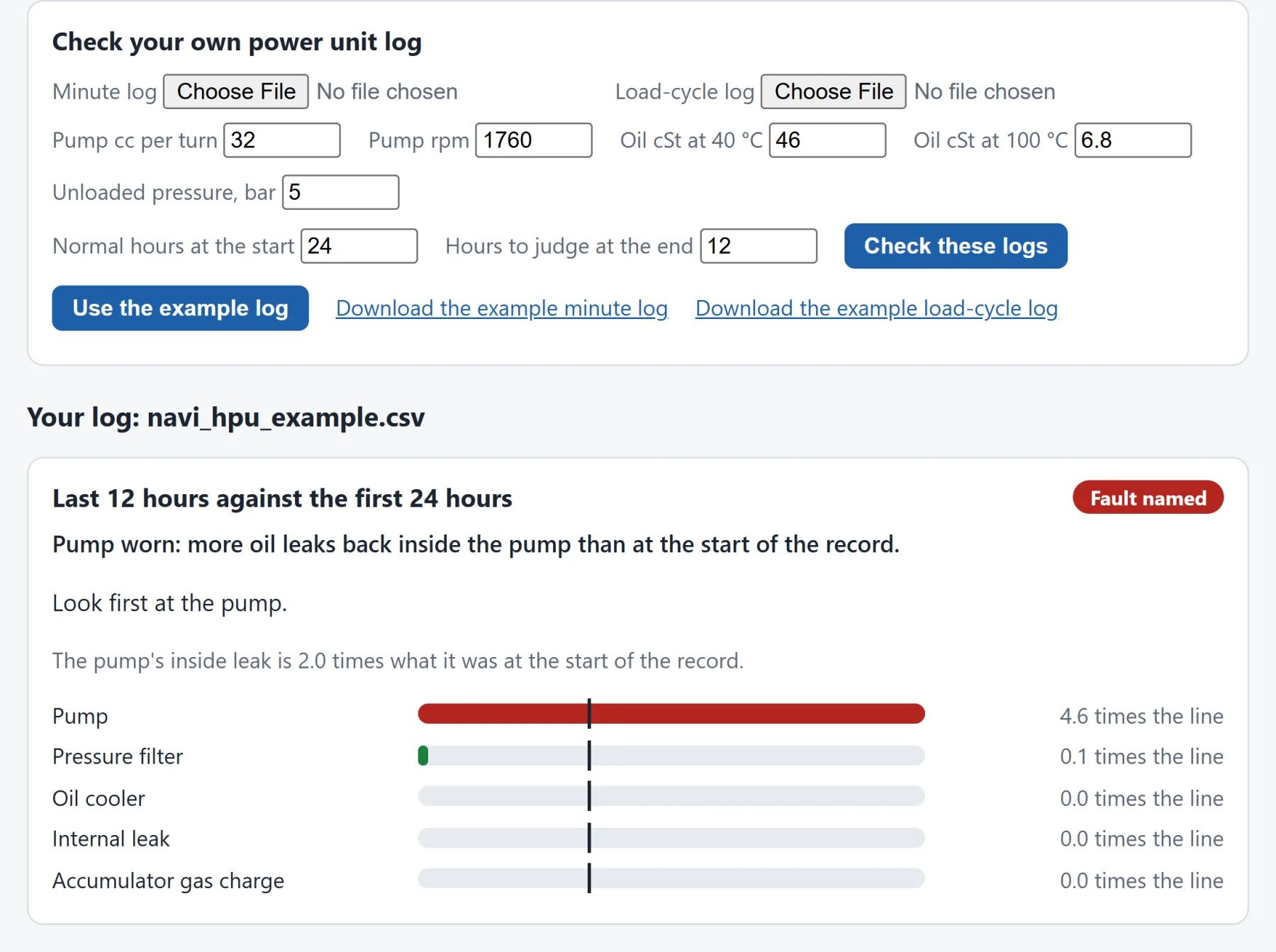
Five parts of the power unit, read from its own logs.
Load the minute log and the load-cycle log. The first hours are read as this unit's normal; the last hours are judged against them. Oil temperature is allowed for.
What goes in. The minute log (pressures, oil and cooling-water temperatures, filter pressure drop, pump case drain, pump loaded, stabiliser on), the load-cycle log, and the pump and oil figures from the nameplate.
What comes out. A bar for each of the five parts against the line where a fault is named, the fault in words, and where to look first.
Pump: more oil leaks back inside the pump; look first at the pump. Filter and cooler: a clogging pressure filter, and an oil cooler that takes less heat out of the oil. Leaks and gas charge: internal leaks while the fins stand still, and a low accumulator gas charge.
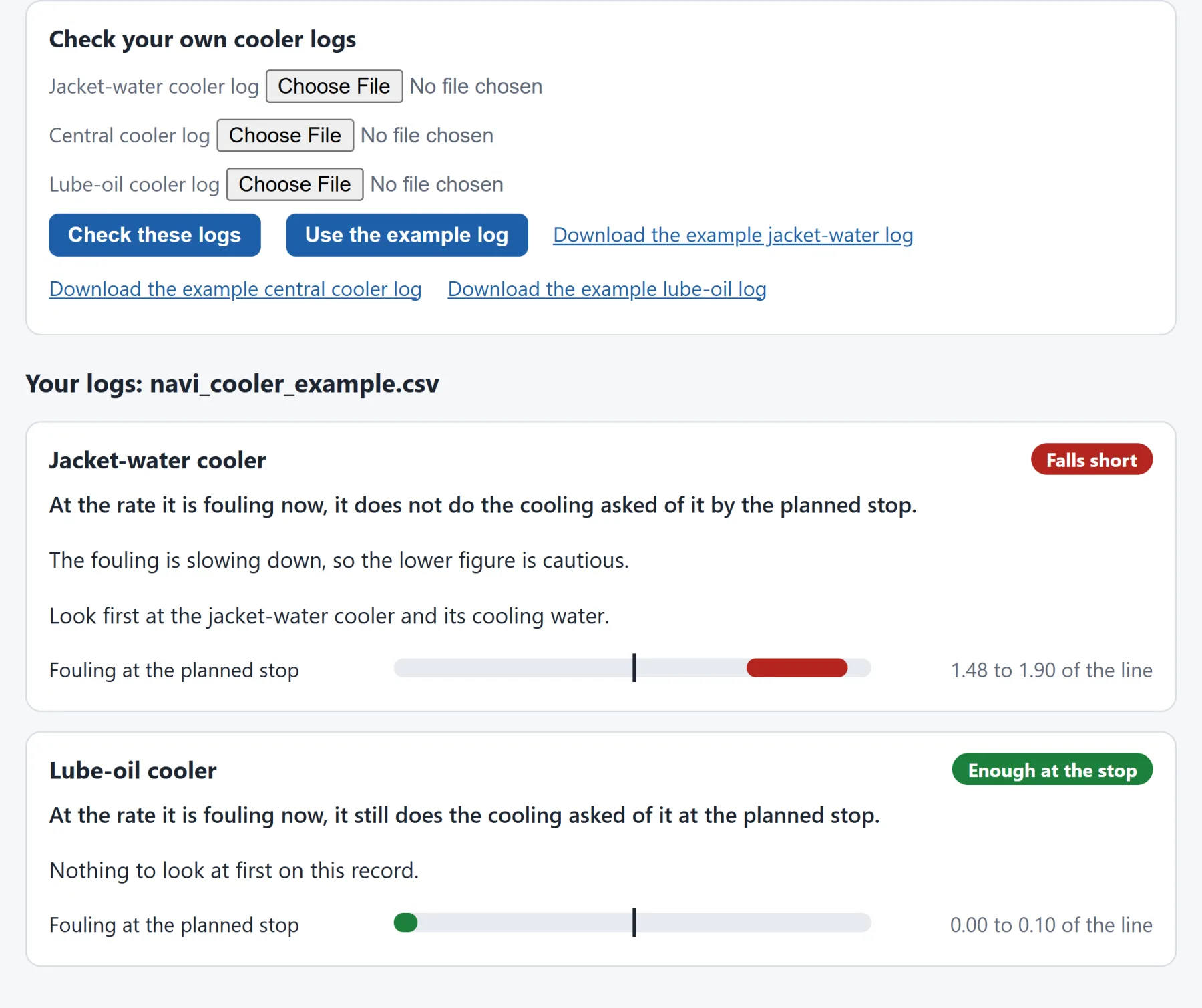
Will each cooler still cool at the planned stop?
Load one log per cooler: jacket-water, central (seawater) and lube-oil. The first days of each log are read as that cooler's normal, and the fouling is carried forward to your planned stop.
What goes in. One log per cooler (one row an hour or one a watch: hours, engine load, temperatures in and out on both sides), the cooler's type and nameplate figures from its datasheet, and the days to the planned stop. Mark cleanings and water-treatment dose changes in the log.
What comes out. For each cooler: how much it will have fouled by the planned stop, against the most it can carry and still do its duty, in plain words.
Three answers: Enough at the stop, May fall short (look again at this cooler's log before the planned stop) and Falls short (look first at the cooler and its cooling water).
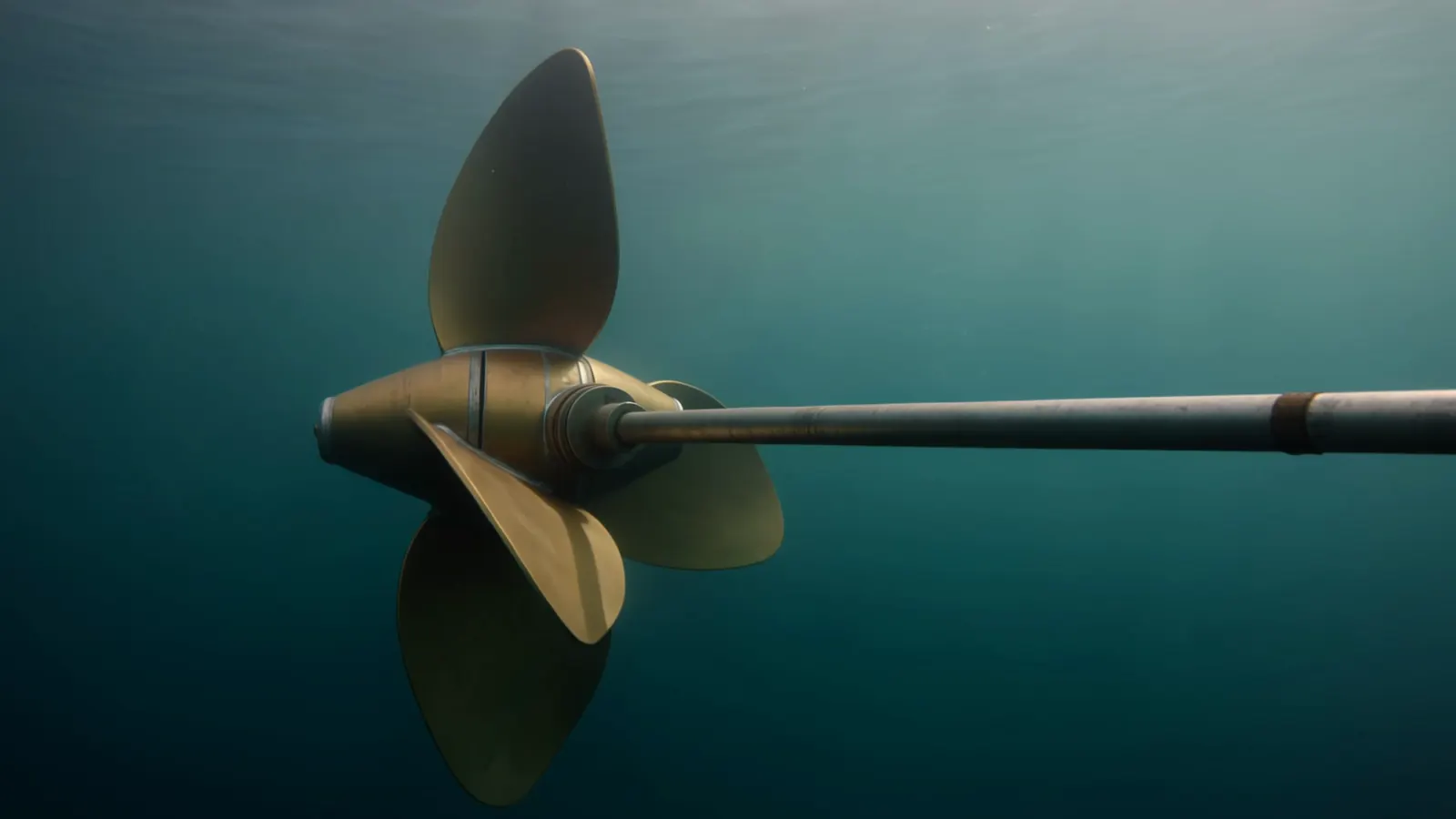
Years of life, as a band you can plan around.
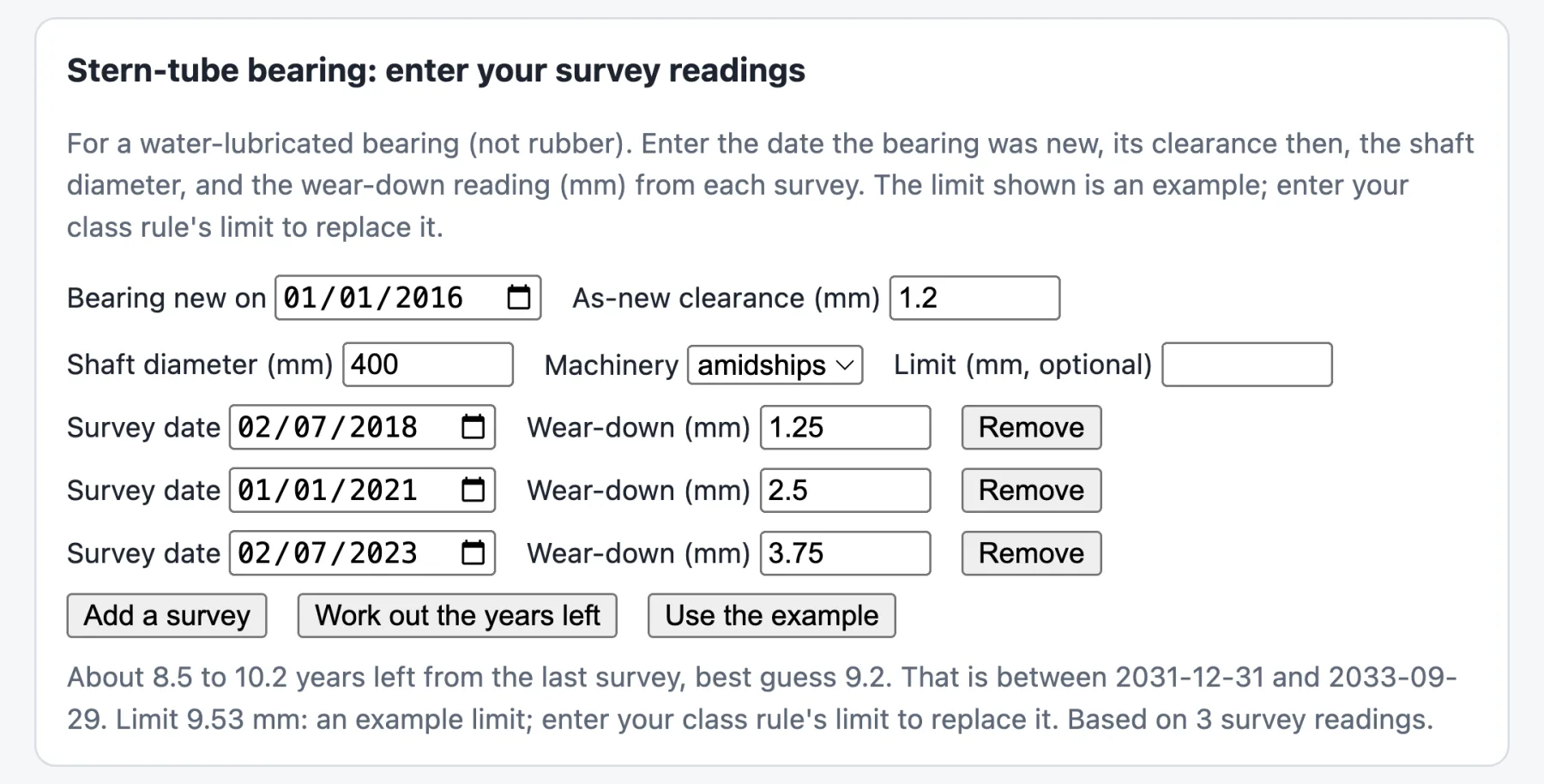
Fill in the stern-tube survey form, or load the coupling surveys, and read the years left as a range. More survey readings narrow the band.
What goes in. Stern tube: the date the bearing was new, its clearance then, the shaft diameter, and one wear-down reading in mm for each survey date. Coupling: your shaft line, the coupling's catalogue stiffness and its place in the list, and the survey CSV.
What comes out. Stern tube: a range of years and a best guess, and the limit they rest on. Coupling: softened or stiffer, and years left as a range.
Enter your class society's figure and it replaces the default, named as yours.
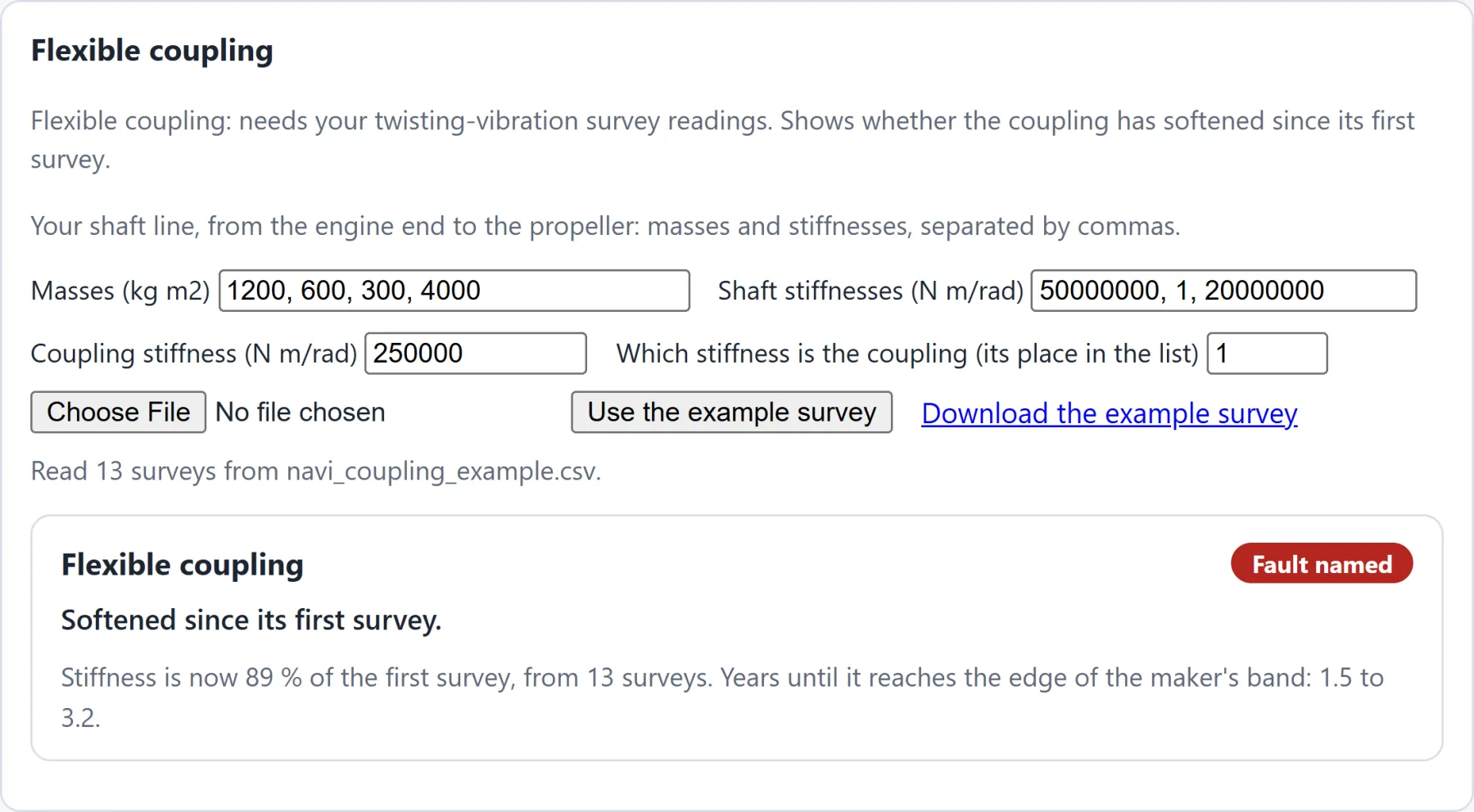
Load the coupling survey. See if it has softened.
Enter your shaft line once and load the twisting-vibration survey readings. The screen shows whether the coupling has softened since its first survey, and the years until it reaches the edge of the maker's band, as a range.
What goes in. Your shaft line from the engine end to the propeller (masses and stiffnesses), the coupling's catalogue stiffness and its place in the stiffness list, and a CSV of survey readings: the survey date, the vibration mode and its frequency.
What comes out. Softened or stiffer since its first survey, how far, and the years until it reaches the edge of the maker's band, as a range.
From set-up to a printed finding, step by step.
One simulated vessel with a clutch drive line, from the first file to the printed report.
Day 1
The drive line is picked: clutch, power unit. The Data screen shows which readings each screen uses.
Day 2
The clutch log is loaded and the normal days are named. The vessel's own normal is set.
Day 3
The first card arrives. Clutch plates grip less than on the normal days. It says: look first at the clutch plates, and check the engagement oil pressure alongside.
Day 4
The gearbox readings are loaded. An oil pressure reading goes flat. CARI-Navi says: sensor problem, check the transmitter range. The gearbox stays out of it.
Day 5
The servo test moves, the fin stabiliser log, the power unit and cooler logs, and the shaft surveys go in. The power unit shows a worn pump; the jacket-water cooler will fall short by the planned stop; the coupling and the stern tube show bands of years left.
Day 6
The vessel's name and date go on the Findings screen: one list, named faults first.
Day 7
The report is printed: one page per machine, each finding ending with what to look at first.
Start with your vessel's own records.
Choose a machine and load its log or survey. You get the verdict, in plain words, with where to look first.
Load your files
Clutch and gear logs, the monitoring system's gear logs, gearbox readings, the servo, fin, pitch and power unit logs, cooler logs, and the coupling and stern-tube surveys.
Each is read by its own screen
The first healthy days set the vessel's own normal and every later day is judged against them.
Read the findings, print the report
A result for each machine you load, one list per vessel, and a printed report with a page for each machine, headed with the vessel and the date. Print it, or save it as a PDF.
Your files stay on your PC
You load your own files on your own computer. They stay with you.
Engine room too
The hydraulic power unit and the engine coolers each have their own screen, read from their routine logs.
Limits on screen
CARI-Navi screens show the line where a fault is named. A reading across it is named, and the bar shows how far. Enter your class society's figure and it replaces the default, named as yours.
Take it to your team.
Short summary
Two pages: what CARI-Navi can do and the eleven machines it covers. PDF · 2 pages · 120 KB
OpenBrochure
Eighteen pages: every screen from the clutch to the stern tube, the findings list, the printed report and a vessel's first week. PDF · 18 pages · 3.8 MB
OpenTechnical annexe
Fifteen pages, for your engineers. PDF · 15 pages · 2.3 MB
OpenCARI-Navi reads the propulsion train. CARI-Chiller watches the cooling plant, and CARI-Loops finds the control loops and valves that need you.
Request a demo. Start with your vessel's own records.
Load a log or survey on your own PC and read the verdict, in plain words, with where to look first. Your files stay with you.